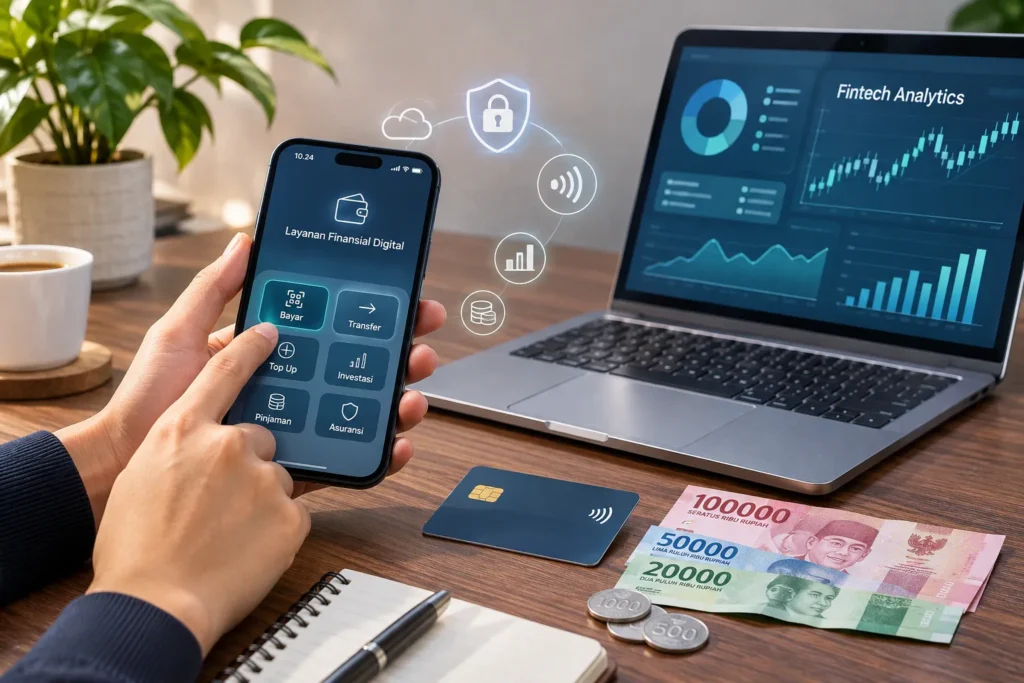
If you have searched for KBBI fintech, you probably want to understand what fintech means in Indonesian, whether the term appears in the Kamus Besar Bahasa Indonesia (KBBI), and how financial technology works in everyday life. The simple answer is that fintech stands for financial technology, referring to the use of technology to provide, improve, or simplify financial services. In Indonesian, the concept is commonly explained using the terms teknologi finansial or teknologi keuangan. Fintech includes services such as digital wallets, online payments, investment applications, digital lending platforms, and technology-driven financial management tools.
However, there is an important distinction between the general meaning of fintech and its official dictionary status. KBBI is a language reference, while institutions such as Bank Indonesia and Otoritas Jasa Keuangan (OJK) provide explanations and regulations for financial technology. This guide explains the meaning of fintech, the Indonesian terminology, its major categories, practical benefits, potential risks, and how to use fintech services responsibly.
What Does KBBI Fintech Mean?
The search phrase KBBI fintech combines two important terms: KBBI and fintech. KBBI stands for Kamus Besar Bahasa Indonesia, Indonesia’s official comprehensive dictionary. It helps readers understand Indonesian vocabulary, word meanings, spelling, and usage. Fintech is an abbreviation of the English expression financial technology. It describes technological innovation applied to financial products and services. When people search for the meaning of fintech in KBBI, they generally want a clear Indonesian explanation of financial technology.
Understanding KBBI Fintech Arti
The Indonesian word arti means meaning or definition. Therefore, the search phrase kbbi fintech arti can be understood as a request for the dictionary meaning of fintech in Indonesian.
A straightforward explanation is:
Fintech adalah penggunaan teknologi untuk menyediakan, mempermudah, dan mengembangkan layanan keuangan.
In English, this means that fintech is the use of technology to provide, simplify, and develop financial services.
For example, imagine someone wants to transfer money to a family member living in another city.
Instead of visiting a bank branch, that person can open a mobile application, enter the recipient’s details, and complete the transaction electronically.
This type of digital financial service illustrates how fintech makes certain financial activities more convenient.
Is Fintech an Official KBBI Term?
It is important not to confuse a commonly used financial term with a verified official dictionary entry.
The official KBBI VI Daring is the appropriate source for checking whether a particular spelling is listed and how it is classified.
The official KBBI materials consulted did not establish a verified individual dictionary entry for the exact spelling fintech. Therefore, this article does not attribute an invented KBBI definition to that spelling.
Possible related expressions include fintek, teknologi finansial, and teknologi keuangan, although their exact dictionary status should also be checked rather than assumed.
The national language agency explains that KBBI records both standard and nonstandard vocabulary, so the presence of a word in the dictionary does not automatically mean every recorded form is recommended for formal writing.
For readers seeking an authoritative explanation of the financial concept, Bank Indonesia provides a useful reference.
What Is Financial Technology?
Financial technology refers to the combination of digital systems and financial services to make activities such as payments, borrowing, saving, investing, and transferring money more accessible or efficient.
According to Bank Indonesia, fintech combines financial services with technology and changes how financial transactions can be conducted, including enabling payments without requiring people to meet physically.
Financial technology does not necessarily replace banks. Instead, it can complement existing financial institutions, improve their services, or introduce alternative methods of delivering financial products.
How Fintech Works
Most fintech platforms rely on connected technological systems that process financial information and execute permitted transactions.
A typical process involves several steps:
-
Registration: The customer creates an account using a mobile application or website.
-
Identity verification: The provider may request identification and verify the user’s identity.
-
Service selection: The customer chooses a payment, transfer, financing, or investment service.
-
Transaction processing: The platform sends and processes information through relevant financial systems.
-
Confirmation: The user receives a transaction status, electronic receipt, or account update.
The exact process depends on the service and the provider’s regulatory requirements.
A Simple Everyday Example
Consider a small coffee shop in Jakarta that accepts digital payments.
A customer orders coffee and pays using a supported QR code through a banking or payment application.
The customer does not need to carry cash, and the merchant receives electronic transaction information.
In Indonesia, QRIS is particularly relevant because it establishes a national QR-code payment standard developed by Bank Indonesia.
This example shows that fintech is not limited to complicated investment platforms. It also supports ordinary transactions between customers and businesses.
Main Types of Fintech Services
Financial technology covers several categories. Understanding them helps beginners identify the purpose of different financial applications.
1. Digital Payments and E-Wallets
Examples include digital wallets such as GoPay, DANA, and OVO. Availability and features vary by provider.
2. Digital Lending and Financing
Digital lending services use online platforms to facilitate financing applications and related processes.
Some platforms connect lenders and borrowers, while others offer different financing models. Borrowers must carefully review interest, fees, repayment schedules, and regulatory status before accepting an offer.
3. Investment and Wealth Management
Investment technology helps users access investment products, monitor portfolios, and organize financial decisions.
Depending on the provider, services may include mutual fund distribution, portfolio analysis, and automated investment recommendations. Investment values can fluctuate, and returns are not guaranteed.
4. Crowdfunding and Digital Capital Raising
Crowdfunding platforms help businesses, projects, or individuals obtain financial support from multiple participants.
Different models may involve donations, rewards, securities, or financing arrangements. These structures have different legal obligations and financial risks.
Other Important Fintech Categories
Financial technology also includes insurance technology (insurtech), financial data aggregation, digital identity verification, fraud detection, and financial infrastructure services.
Not all digital financial companies perform the same activities. An application that processes payments operates differently from one that facilitates securities investments or loans.
This distinction becomes particularly important when evaluating regulation and consumer protection.
Benefits of Fintech for Consumers and Businesses
Fintech can provide meaningful advantages when the technology is reliable, secure, and used appropriately.
1. Greater Convenience
Many financial activities can be completed through mobile applications without visiting a physical branch.
This can help customers manage routine transactions outside conventional office hours, although service availability and processing times depend on the provider.
2. Faster Transactions
Digital systems can automate steps that previously required manual paperwork.
For example, electronic payments often generate immediate transaction notifications. However, notifications do not always mean the final settlement of funds has occurred.
3. Broader Financial Access
Digital platforms may help people in underserved areas access selected financial services without traveling to major cities.
Nevertheless, internet access, digital literacy, identification requirements, and eligibility criteria can still create barriers.
4. Easier Financial Recordkeeping
Electronic transaction histories make it easier to review spending, compare previous payments, and identify unexpected account activity.
For small businesses, transaction records can also support bookkeeping and financial planning.
5. More Opportunities for Innovation
Fintech encourages financial institutions and technology companies to develop better tools for customers.
These may include automated budgeting services, payment integration for merchants, and digital financial education.
Risks and Challenges of Financial Technology
Although fintech offers useful benefits, digital convenience does not eliminate financial risk.
Consumers should understand several major challenges before using financial applications.
Cybersecurity and Data Privacy
Fintech providers often process sensitive financial and personal information.
If systems or user accounts are compromised, customers may experience fraud, unauthorized access, or exposure of private data.
Strong authentication, responsible data handling, and regular security updates are essential.
Online Financial Scams
Fraudsters sometimes impersonate legitimate financial providers through fake applications, websites, and social media accounts.
They may advertise unrealistic returns, request upfront payments, or pressure people to disclose verification codes.
An attractive mobile application does not prove that a financial business is legitimate.
Borrowing and Repayment Risks
Digital borrowing can feel easy because applications may be completed quickly.
However, an affordable-looking installment can become expensive when fees and the complete repayment amount are not considered.
For example, a borrower who receives Rp2,000,000 but must repay Rp2,400,000 should examine the Rp400,000 difference, the repayment term, and any additional charges.
Limited Digital Literacy
Some users may not understand the differences between regulated investments, digital payment balances, online lending, and high-risk financial products.
As a result, financial education remains just as important as access to technology.
Fintech Regulation in Indonesia
Financial technology in Indonesia operates within a regulatory environment involving several authorities and legal frameworks.
Two particularly important institutions are OJK and Bank Indonesia.
Role of OJK
Otoritas Jasa Keuangan (OJK) is Indonesia’s financial services authority.
OJK oversees various activities within the financial services sector and has established rules for innovation in digital finance.
One important framework is OJK Regulation No. 3 of 2024, concerning Inovasi Teknologi Sektor Keuangan (ITSK), or financial-sector technological innovation.
The regulation covers matters such as innovation testing, licensing or registration processes where applicable, monitoring, consumer protection, and personal data protection.
It took effect on February 19, 2024.
What Is a Regulatory Sandbox?
A regulatory sandbox is a supervised testing mechanism for qualifying financial innovations.
It allows regulators to evaluate certain new financial technologies and business models within an established framework.
A company participating in a sandbox should not automatically be treated as fully licensed for every financial activity.
Its exact regulatory standing must be verified.
Role of Bank Indonesia
Bank Indonesia plays a central role in the country’s payment system.
It establishes policies and standards relevant to regulated payment activities and financial technology within its jurisdiction.
Its educational materials describe how fintech supports technological changes in payment services and financial transactions.
Bank Indonesia’s earlier fintech regulatory framework, Regulation No. 19/12/PBI/2017, also addressed technological innovation in payment-related financial services.
Readers should distinguish historical rules from the current requirements applicable to a specific service.
Why Regulation Matters
Regulation helps establish responsibilities, oversight arrangements, and consumer protection requirements.
However, being regulated does not guarantee that an investment is profitable, a loan is affordable, or a platform is free from operational problems.
Consumers should still evaluate the actual service and the risks involved.
Fintech vs. Traditional Banking: Key Differences
Fintech and traditional banking both provide financial services, but they often differ in their delivery methods, technology, and business models.
The comparison below highlights their typical characteristics.
| Feature | Fintech | Traditional Banking |
|---|---|---|
| Primary approach | Technology-driven financial solutions | Broad banking services |
| Customer access | Often mobile-first or online | Branches, websites, and mobile apps |
| Product focus | Frequently specialized services | Deposits, lending, payments, and other banking products |
| Account opening | Often digital | Digital or branch-based |
| Customer support | Commonly digital channels | Digital and in-person channels |
| Regulation | Depends on financial activity | Banking regulations and supervision |
| Main advantage | Specialized innovation and convenience | Broad financial infrastructure and banking services |
Can Fintech Replace Traditional Banks?
Not entirely.
Fintech can provide alternatives for specific financial activities, but banks continue to serve important functions such as accepting regulated deposits, providing credit, and supporting the broader financial system.
Furthermore, many traditional banks already use financial technology.
A bank offering mobile transfers, digital account opening, and electronic payments is using technology to improve its services.
The relationship between banks and fintech companies can therefore be competitive, cooperative, or both.
How to Choose a Safe Fintech Platform
Understanding KBBI fintech arti is useful, but knowing how to evaluate actual financial services is even more important.
Before registering for a financial application, users should check its legitimacy, service conditions, and security features.
Practical Safety Checklist
Why Regulatory Verification Is Important
A company may advertise itself as a financial technology provider without holding the authorization required for its activities.
Consumers can start with the official websites of OJK and Bank Indonesia to find relevant regulatory information.
The appropriate regulator depends on the type of financial service.
For QRIS payments, Bank Indonesia advises consumers to use applications from licensed payment service providers and verify the merchant’s name before completing transactions.
The Future of Fintech in Indonesia
Financial technology continues to create opportunities for innovation across Indonesia’s financial ecosystem.
Several developments are particularly important.
Artificial Intelligence in Financial Services
Artificial intelligence can help financial providers analyze data, detect suspicious transactions, automate customer assistance, and improve certain operational processes.
However, AI-based financial services also raise questions about privacy, accountability, and the fairness of automated decisions.
Expansion of Digital Payments
Electronic payment systems make it easier for customers and merchants to conduct transactions across different platforms.
QRIS demonstrates how common payment standards can improve interoperability.
Bank Indonesia explains that QRIS enables participating payment applications to work across different payment service providers and merchants.
Greater Focus on Cybersecurity
As financial services become more digital, the protection of customer information becomes increasingly important.
OJK has published cybersecurity guidance and anti-fraud materials for financial-sector technology providers.
These initiatives reflect the importance of protecting financial systems as they evolve.
More Accessible Financial Education
Digital financial tools may also make educational resources easier to access.
Budgeting applications, investment learning platforms, and financial calculators can help people understand financial concepts.
Nevertheless, financial knowledge and responsible decision-making remain essential. Technology alone cannot eliminate poor financial choices.
People’s Frequently Asked Questions About KBBI Fintech
1. What is the meaning of KBBI fintech?
KBBI fintech is a search phrase commonly used to find the Indonesian meaning of financial technology. Fintech refers to technology used to provide, improve, or simplify financial services.
2. What does kbbi fintech arti mean?
The phrase kbbi fintech arti refers to a search for the meaning of fintech in the Indonesian dictionary. A simple Indonesian explanation is teknologi yang digunakan untuk menyediakan dan mengembangkan layanan keuangan.
3. What are some examples of fintech in Indonesia?
Examples include digital wallets, QRIS-enabled payment services, online financing platforms, digital investment applications, and financial management tools.
4. Is fintech the same as online banking?
No. Online banking is a digital delivery channel for banking services, while fintech is a broader concept covering various financial technologies, services, and business models.
5. Is fintech safe to use?
Fintech services can be useful and secure, but safety depends on the provider, regulatory compliance, technology, and user behavior. Always verify a provider’s legitimacy and understand the financial risks.
6. Who regulates fintech in Indonesia?
Regulation depends on the financial activity. OJK oversees various financial services and innovations, while Bank Indonesia has responsibilities relating to payment systems.
7. Does fintech always involve lending money?
No. Lending is only one category. Fintech also includes electronic payments, investment platforms, financial data services, and other digital financial solutions.
Conclusion
The term KBBI fintech reflects growing interest in understanding financial technology and its meaning in Indonesian. Fintech, short for financial technology, describes the use of technology to improve how financial products and services are delivered. Common examples include digital payments, electronic wallets, online financing, and investment applications. For anyone researching kbbi fintech arti, the most important distinction is between a dictionary definition and the broader financial concept. Official dictionary entries should be checked through KBBI, while Bank Indonesia and OJK provide authoritative information about financial technology and its regulation.
Fintech can make financial services more accessible and convenient, but consumers should also consider cybersecurity, financial costs, privacy, and regulatory status. Understanding these fundamentals helps beginners make better decisions when choosing and using digital financial services.